
Checking Criminal History in Laurens County
A sound Laurens County search begins with the event, not a broad name query. Identify the arresting agency, rough date, place, and any case or booking number. A fresh custody event may appear first in the Johnson Detention Center roster. A filed prosecution belongs in the South Carolina Judicial Branch Case Records Search. The South Carolina Law Enforcement Division, or SLED, supplies the statewide name-based CATCH product. Each layer has a different job.
Names can produce false matches. Keep the full legal name, date of birth, spelling variants, and known aliases close at hand. Compare the charge, agency, case date, and disposition before treating two entries as the same event. Then follow a short source chain.
- Search the official jail roster when the event is recent and current custody is possible.
- Select Laurens in Case Records Search, then check General Sessions and the proper magistrate or municipal court.
- Read each charge and disposition separately. One case can contain several different outcomes.
- Order the filed document from the Clerk of Court when an online summary is not enough.
- Use SLED CATCH for the South Carolina repository layer, then correct any missing outcome with certified court proof.
Three Laurens Criminal Record Systems
Laurens County criminal history lives in three main systems because booking, prosecution, and repository reporting occur at different times. The Zuercher inmate interface answers recent county custody questions. Case Records Search shows court filings and their outcomes. SLED CATCH returns a name-based South Carolina criminal-history report drawn from the central repository.
| Layer | Best answer | Main limit |
|---|---|---|
| Jail booking | Recent intake, charge wording, bond, custody | Does not prove guilt or final charge |
| Court case | Filed charge, docket events, disposition, sentence | Does not establish statewide completeness |
| SLED CATCH | South Carolina name-based repository history | Excludes wanted status and can miss aliases |
The result is a sequence: arrest and booking → charging decision → court disposition → repository update. A gap at one step calls for the office that created that step's record.
Summary jurisdiction adds another branch. Magistrate and municipal courts ordinarily hear offenses within their statutory reach, while General Sessions handles felonies and charges beyond that limit. Clinton and Fountain Inn keep municipal case records, and Fountain Inn may appear under Greenville in the statewide participating-court help. Choose the venue before deciding that a name search failed.
South Carolina Official Background Checks
SLED is the South Carolina criminal-history repository. CATCH is its public, name-based product. It searches South Carolina data, requires name and date-of-birth details, and uses starts-with matching. Wanted-person information is not included. Online CATCH costs $25 plus the posted service fee. A qualifying charitable organization pays $8 plus its posted fee. Mail requests avoid the online service fee and must use an accepted certified form of payment.
Fingerprint checks are different. SLED processes them only when a statute or program authorizes the request. The responsible program supplies an authorization or service code and routes capture through IdentoGO enrollment. For a federal self-review, the subject can request an FBI Identity History Summary with fingerprints. Neither product replaces a Laurens County certified case file.
A person reviewing their own federal record can submit fingerprints electronically, mail a fingerprint card, or use an approved FBI channeler. The FBI result can contain federal data and records contributed by states. If a Laurens expungement remains in that federal summary, SLED directs the subject to contact its CJIS unit with the local order and supporting report.
| Official product | Coverage | Published cost |
|---|---|---|
| SLED CATCH | South Carolina name-based history | $25 plus posted online fee |
| Reduced CATCH | Eligible charitable organization search | $8 plus posted online fee |
| Laurens Clerk copies | Filed General Sessions documents | $0.50 per page |
| Fingerprint check | Program-authorized state or federal result | Program-specific |
Laurens County SLED Record Search
CATCH works best when the person uses the same identifiers attached to the record. The official search requires a last name, first initial, and date of birth. A full first name and middle name help narrow a common match. The result can be ordered online or by mail, but the search is not a national check and no result proves that no warrant exists.
| Field | Use | Matching note |
|---|---|---|
| Last name | Required text | Starts-with matching |
| First initial | Required text | Add full first name when known |
| Date of birth | Required date | Critical for separating similar names |
| Middle name | Optional text | Useful for identity comparison |
The official CATCH screen shows the current fee before checkout. This source image reflects the state portal used for the statewide layer.
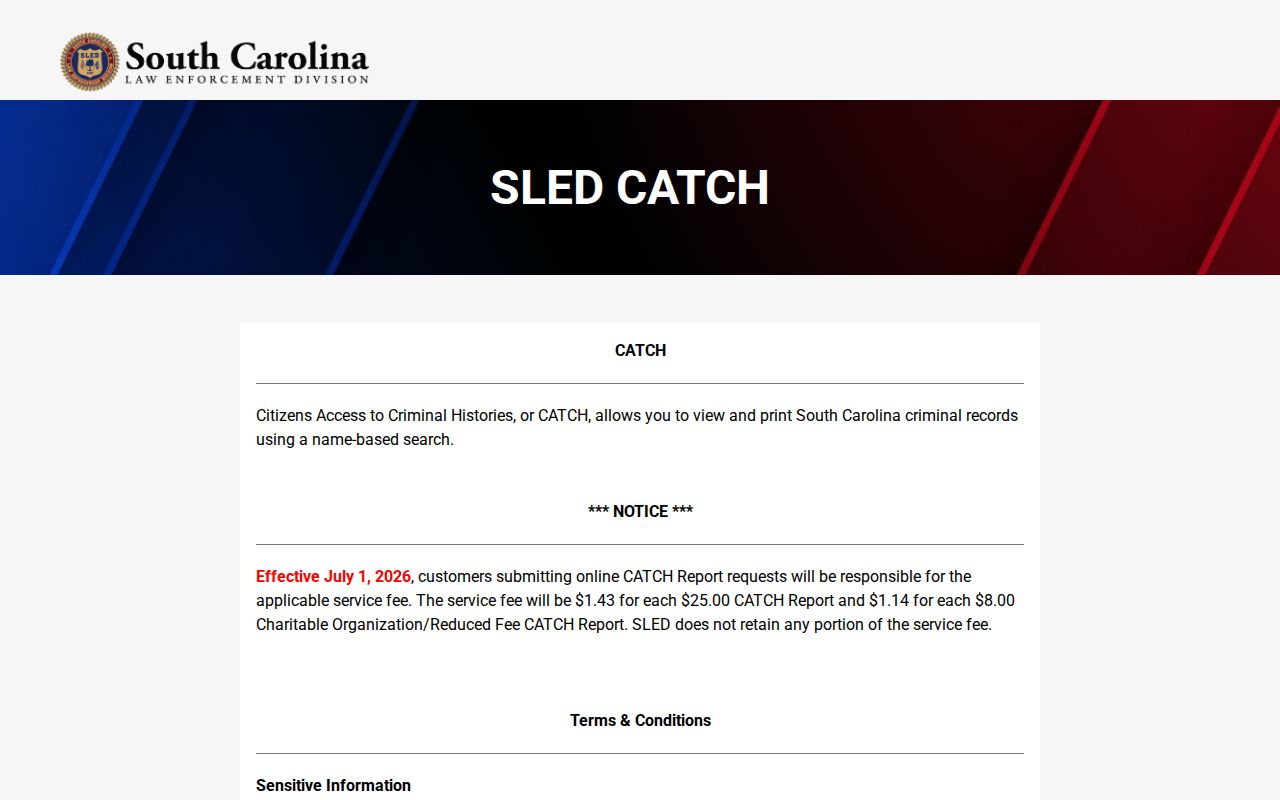
CATCH should be compared with the Laurens court disposition when a charge ended by dismissal, no bill, or another non-conviction result.
Criminal Record Types
A Laurens County criminal record is not one document. The arresting agency writes an incident or arrest report. Johnson Detention Center creates booking and custody data. A judge creates warrant, bond, and initial-hearing records. The Clerk of Court maintains General Sessions files, while magistrate and municipal clerks keep their own summary cases. SLED links qualifying fingerprint-supported arrests with reported dispositions.
- Booking record
- The jail intake record, including booking date, initial charge, agency, bond, and custody status.
- Disposition
- The court's outcome for one charge, such as guilty, dismissed, no bill, or not guilty.
- Rap sheet
- A repository history that connects reported arrest cycles with dispositions.
- Bench warrant
- A judge's order used to enforce a missed court appearance or other court command.
- Expungement
- A court-ordered process that removes qualifying arrest and court records from public view.
Custody and supervision split again. The South Carolina Department of Corrections inmate search covers current sentenced state prisoners, not people in the county jail or under probation and parole supervision.
Laurens County Records at Hillcrest
The restored courthouse on Public Square is a landmark, but it is not the active General Sessions records counter. The Clerk of Court operates at 100 Hillcrest Square, Laurens, SC 29360. Criminal files are kept perpetually, and the published copy rate is $0.50 per page. Call 864-984-3538 to arrange review or ask about a certified copy. The sheriff's office is at 216 W. Main Street, while Laurens Police uses the municipal complex at 250 W. Laurens Street.
Clerk of Court
100 Hillcrest Square
Laurens, SC 29360
864-984-3538
Laurens County Sheriff
216 W. Main Street
Laurens, SC 29360
864-984-4967
Johnson Detention Center
County booking and custody records
864-683-4055
The Eleventh Judicial Circuit Solicitor handles General Sessions prosecution and qualifying circuit expungement work.
The solicitor's records explain how a filed charge may differ from the allegation entered during booking.
City reports begin elsewhere. Laurens Police is at 250 W. Laurens Street. Clinton Police is at 404 N. Broad Street and supplies an online city FOIA form for incident reports. Fountain Inn Police should be asked which county received a booking because the city crosses the Laurens and Greenville line. Following the arresting badge avoids sending every request to the sheriff.
Inside a Laurens County Criminal Record
Case and booking screens place facts in separate fields. Read the identity fields first, then treat each charge as its own row. An arrest date can differ from a filing date. The same case can show one guilty outcome and one dismissal. A sentence entry may include custody, suspended time, credit served, probation, fines, or restitution.
| Name and identifiers | Party name, alias, date of birth, sex, race, and address fields where public |
|---|---|
| Case controls | Case number, court, filing date, agency, warrant, indictment, and solicitor number |
| Charge data | Offense description, statute, degree, count, and arrest date |
| Disposition | Plea, verdict, dismissal, no bill, nolle prosequi, and outcome date |
| Sentence | Custody, suspended time, credit, probation, fine, restitution, and conditions |
| Events | Bond, hearings, motions, counsel, appeals, and filed documents |
Online entries are useful indexes. The filed item from the responsible Laurens County clerk is the authoritative copy.
Laurens County Warrant Record Fallbacks
No official public sheriff warrant-name portal was found for Laurens County. CATCH explicitly leaves out wanted persons. Search the relevant court case for a warrant event, then call the issuing clerk. General Sessions criminal warrants remain with the Laurens Clerk. Bench warrants can arise in General Sessions, magistrate court, or municipal court, so a missed Clinton case belongs with Clinton Municipal Court.
For a sheriff fallback, call 864-984-4967 or submit a focused South Carolina Freedom of Information Act request for releasable warrant information. A blank online result is not proof that no warrant exists. To resolve a warrant, ask the issuing court or counsel for appearance, surrender, and bond instructions, then obtain written confirmation of any recall.
Public Access Laws in South Carolina
The South Carolina Freedom of Information Act starts with public access, then permits specific redactions and exemptions. Crime reports and documents identifying people confined in a jail during the prior three months receive express treatment. Active-investigation details, juvenile data, victim information, medical data, and material that risks safety or a fair trial can remain restricted.
Key South Carolina laws:
Code § 30-4-30 sets the public-record request and response framework.
Code § 30-4-40 lists exemptions that can support withholding or redaction.
Code § 30-4-50 addresses access to crime reports and recent confinement-identification records.
Code § 23-3-115 governs dissemination from the state criminal-history repository.
A request should name the agency, date range, incident or case number, exact record, desired format, and delivery method. Ask for an estimate when a fee is not published.
South Carolina FOIA distinguishes the agency's determination from actual production. The government may confirm whether a record is public before it finishes gathering and redacting responsive pages. Narrow wording helps both stages. Ask separately for an incident report, body or dash video, 911 audio, or CAD log because one label may not capture all formats.
Laurens County Custody Records
Johnson Detention Center covers county intake and local custody. SCDC covers people currently serving a state prison sentence as of the prior midnight. Its locator does not include released people, county detainees, probation, or parole. Search both systems only when the case history supports both stages.
The SCDC inmate search source explains the statewide prison locator's limits.
DPPPS, not SCDC or Laurens County, manages adult probation and parole supervision.
The DPPPS source identifies the agency responsible for South Carolina community supervision.
Public court entries may show the supervision sentence and later violation hearings, while operational supervision details can remain protected.
Sealed, Expunged, and Restricted Records
South Carolina expungement requires a qualifying legal basis and a court order. A dismissal does not, by itself, certify that every public system has removed the arrest. Juvenile matters and sealed records also follow separate access limits. The Eleventh Circuit Solicitor handles many Laurens General Sessions applications, while the disposing summary court may handle its own qualifying case.
The 2026 Eleventh Circuit application requires separate U.S. Postal Service money orders for the solicitor, SLED, and clerk components when those fees apply. Applicants should use the current category chart because eligibility, waiting periods, and costs vary by disposition and statute.
The Eleventh Circuit expungement source describes the local process.
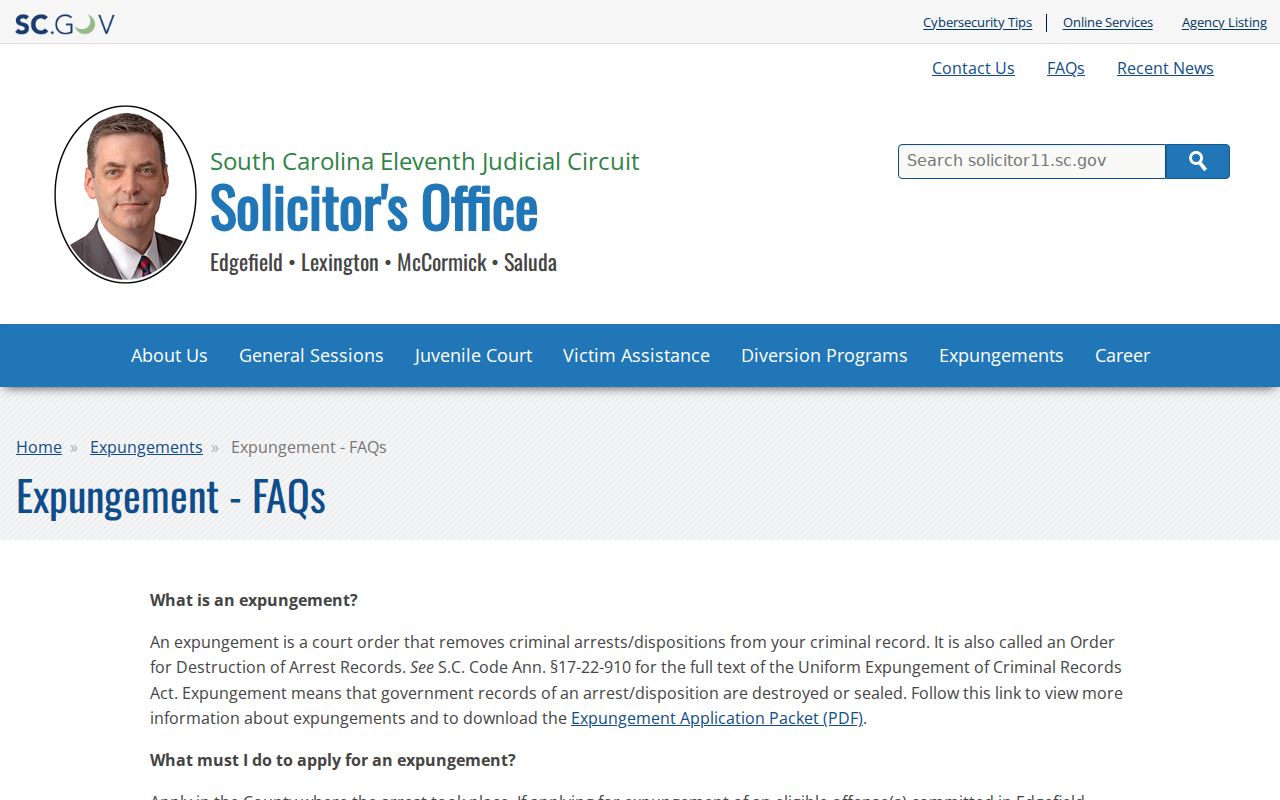
After an order reaches SLED, the agency advises waiting four weeks before buying a confirmation CATCH report.
Fix a Laurens County Record
Start with the office that made the disputed entry. Ask the arresting agency about report or booking identity data. Ask the court clerk about a plea, dismissal, sentence, or missing disposition. Obtain a certified disposition before contacting SLED about the repository record. SLED cannot expunge a charge without a court order.
When an old charge remains after expungement, SLED asks for a certified true copy of the order, a recently purchased CATCH report, and a stamped self-addressed envelope mailed to its Expungement Department. For a federal self-review, the FBI Identity History Summary is subject-only and requires fingerprints.
Classification affects the route. South Carolina groups many felonies and misdemeanors by statutory maximum, but an offense statute can supply its own penalty or exception. The commonly used first-offense summary route in Section 22-5-910 is limited by maximum punishment, exclusions, waiting rules, and prior history. Read the current application category rather than assuming that a dismissal and a conviction use the same process.
The federal Bureau of Prisons locator is a separate custody source.
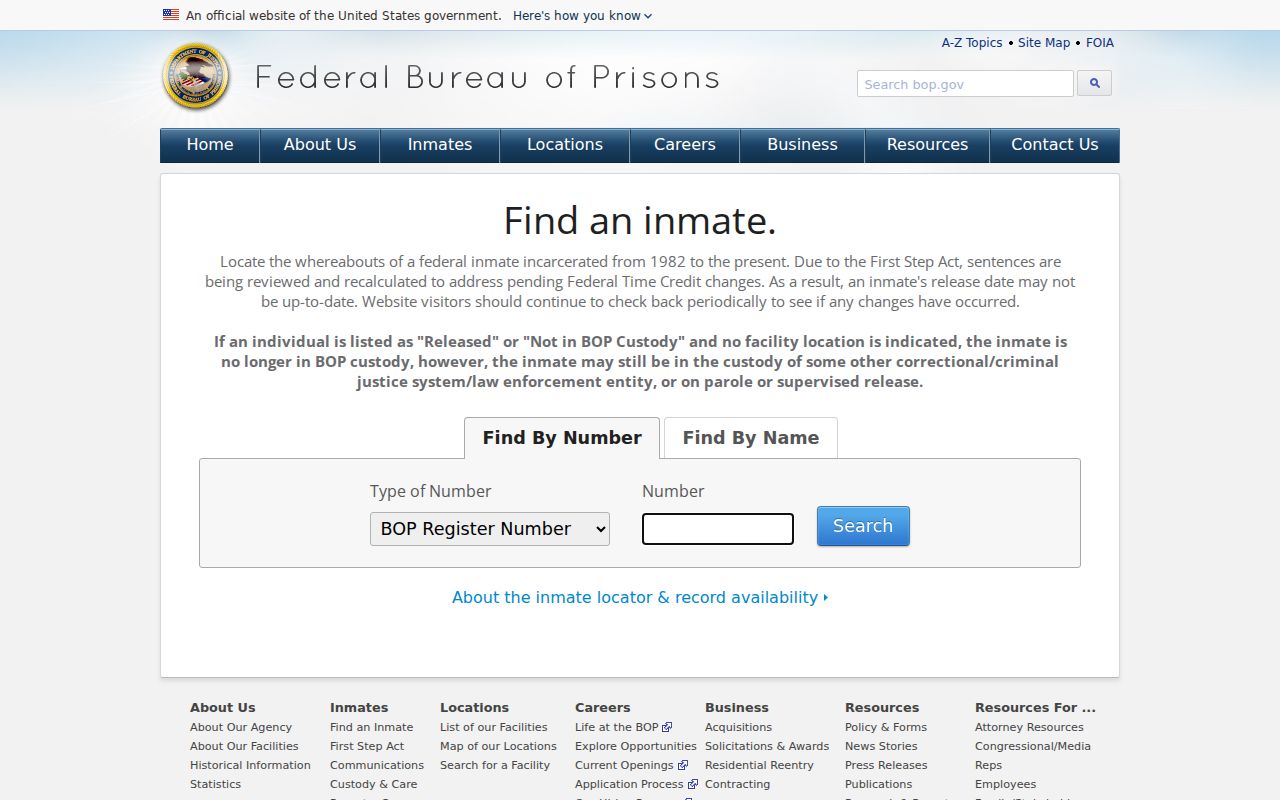
Federal court filings require another channel, even when the investigation began in Laurens County.
Laurens County Federal Criminal Cases
A local investigation can lead to federal charges. County booking data will not tell the full federal prosecution story. The District of South Carolina court supplies the filed case, while PACER provides federal electronic docket access. The Bureau of Prisons locator applies only after federal custody criteria are met.
The PACER source is the official electronic access point for federal court dockets.
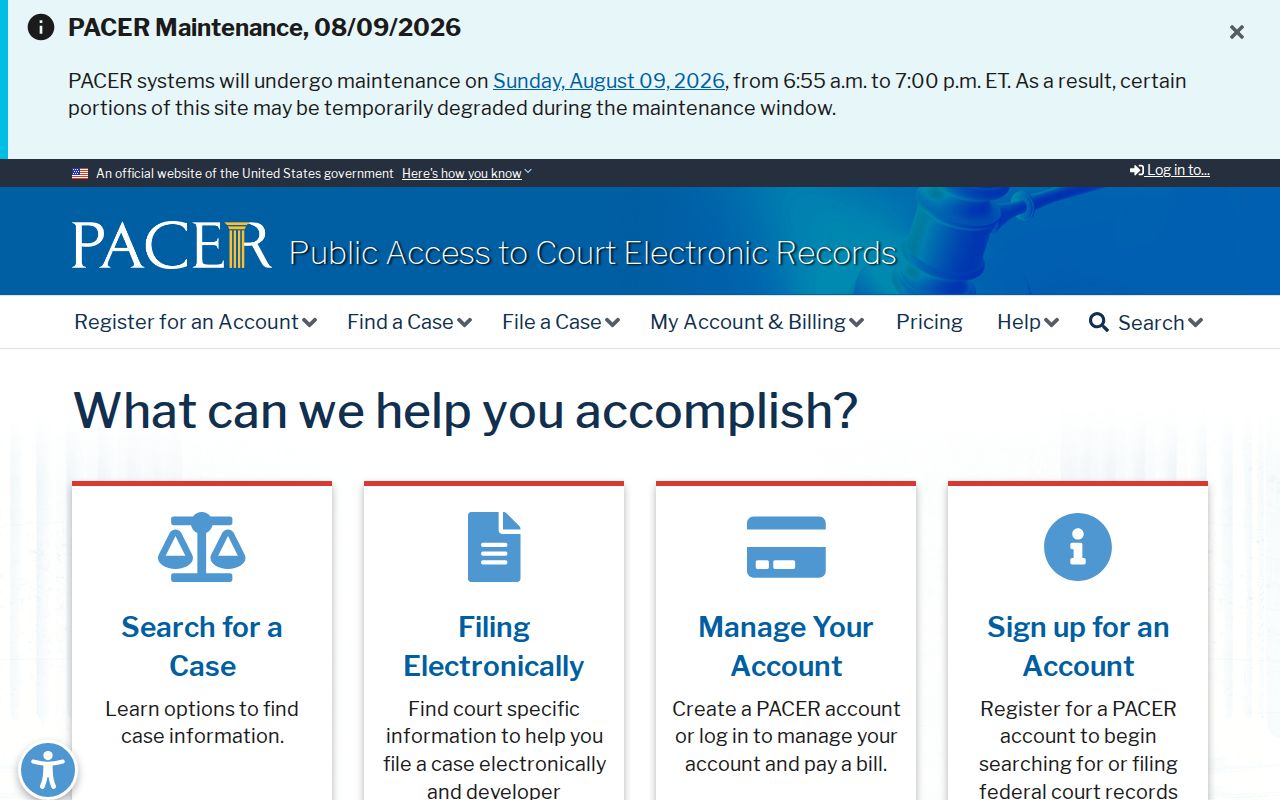
Search county and federal systems separately when the responsible prosecutor changes.
Laurens County Criminal Records by City
City police departments create their own incident and arrest reports, and municipal courts keep summary cases. The ranked city set also has one major boundary issue: Fountain Inn crosses Laurens and Greenville Counties. Use the incident location to choose the correct county booking and General Sessions systems.
Fountain Inn Criminal Records
Two-county routing makes the incident location essential.
Laurens Criminal Records
City police reports, municipal cases, and county files use distinct offices.
Clinton Criminal Records
The city offers an online FOIA route and a separate municipal court counter.