
Laurens County Criminal Records Laws
No single law or office governs every criminal record. An incident report belongs with the sheriff or police department that created it. Johnson Detention Center maintains booking and confinement information. General Sessions filings remain with the Laurens County Clerk of Court, while magistrate and municipal clerks preserve their own summary cases. SLED maintains the fingerprint-supported statewide criminal-history repository. Each custodian applies the South Carolina Freedom of Information Act, court rules, confidentiality laws, and valid sealing or expungement orders to its own material.
That division matters when two screens disagree. A jail entry can show an intake charge before the Eleventh Judicial Circuit Solicitor makes a charging decision. The court file later records the disposition. SLED updates its criminal history from fingerprint-supported arrest submissions and reported outcomes. A request sent to the wrong office may yield no record even though another official custodian has it. Use the record’s origin, case number, arrest agency, and date to choose the right source.
Laurens County FOIA Response Clocks
S.C. Code §30-4-30 creates a right to inspect, copy, or receive public records electronically, subject to exemptions and reasonable rules for time and place. For records less than twenty-four months old, a public body must make a written determination about availability within ten working days. For older records, that determination period is twenty working days. Production then follows within thirty or thirty-five calendar days, respectively, unless the requester and agency reach a written agreement.
| Record age | Availability decision | Production after decision |
|---|---|---|
| Less than 24 months | Within 10 working days | Within 30 calendar days |
| 24 months or older | Within 20 working days | Within 35 calendar days |
| Written agreement | As agreed | As agreed by requester and public body |
The first deadline concerns the agency’s determination, not necessarily delivery of every page. Search, copy, and redaction charges may apply. Ask for an estimate and set a cost ceiling when a request could be broad. A public body may also set reasonable inspection arrangements. The statute does not convert a request into a demand that staff create a new report or answer legal questions.
The South Carolina General Assembly publishes the controlling FOIA text.
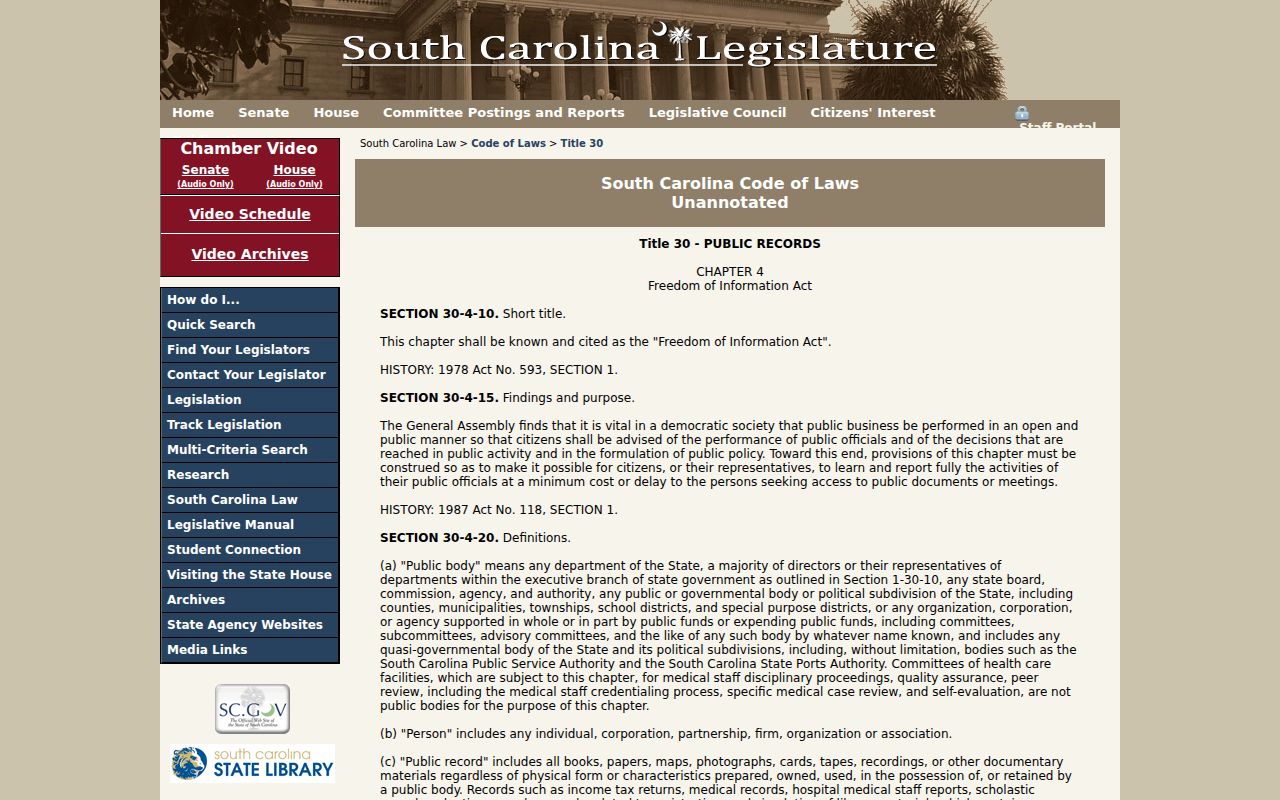
The official code is the best source for the current response clocks, public categories, fee rules, and exemptions applied by Laurens County custodians.
Requesting Laurens County Criminal Records
The Laurens County Sheriff does not publish a dedicated records portal, form, fee schedule, email, fax, or walk-in schedule in the reviewed official material. Start at 216 West Main Street or call the front desk at 864-984-4967. Johnson Detention Center can be reached at 864-683-4055 for current custody questions. A written request should identify the exact incident report, arrest report, booking entry, dispatch record, audio, warrant information, photograph, or video sought.
- Identify the agency, event date, location, involved names, and case, booking, or warrant number if known.
- State whether inspection, paper copies, or electronic delivery is preferred and describe the record narrowly.
- Ask for an advance fee estimate, give a willingness-to-pay ceiling, and request nonexempt portions if other content is withheld.
- Send the request to the office that created or preserves the record, then keep the submission and written response.
- If the issue is a filed disposition or certified case document, use the responsible clerk rather than an agency FOIA request.
Clinton Police provides an online city FOIA form for its incident reports. Laurens Police and Fountain Inn Police requests begin with their city departments. Highway Patrol records start with the South Carolina Department of Public Safety. The Laurens County Clerk sells nonsealed General Sessions copies for $0.50 per page at 100 Hillcrest Square, Suite B, but online docket text is not a certified copy.
Laurens County Crime and Jail Access
FOIA draws special attention to two useful criminal-record categories. Section 30-4-50 treats reports that disclose the nature, substance, and location of a crime as public, while allowing protected portions to be deleted. Section 30-4-30 also calls for documents identifying people confined during the preceding three months to be available during business hours without requiring a written request, unless an exemption applies. These rules support access, but they do not require release of victim details, juvenile material, medical data, or information that would harm an active investigation.
The Laurens County Zuercher interface is the fastest official channel for current or recent detention data. Historical booking material or a field not shown online may require a focused request to the sheriff or detention center. The incident report still comes from the arresting agency, which might be a city police department rather than the sheriff. A booking record proves intake, not guilt. The filed court disposition is the better source for what ultimately happened to a charge.
Public does not mean unrestricted: Laurens County offices may redact exempt portions while releasing the rest. Ask the custodian to separate nonexempt material rather than treating one protected field as a reason to withhold an entire record.
Restricted Laurens County Criminal Records
FOIA does not override a sealed order or a statute that makes information confidential. Juvenile records, expunged cases, confidential victim and minor identifiers, personal identifiers, medical and security information, and parts of active investigations may be withheld or redacted. Grand-jury material and sealed warrants can also remain unavailable. Online court displays suppress sensitive information even when a nonsealed paper file can be inspected at the clerk’s counter.
| Juvenile material | Restricted by special confidentiality rules rather than ordinary public access. |
|---|---|
| Sealed cases | Hidden or limited according to the court’s order and governing law. |
| Expunged matters | Removed or destroyed from public criminal-record channels after a valid order is processed. |
| Victim and minor data | Names, contact details, and sensitive facts may be protected or redacted. |
| Active investigations | Investigatory facts may be withheld when an exemption applies. |
| Medical and security data | Health, jail classification, safety, and system-security details are not presumed public. |
If an online search shows nothing, ask the clerk whether the matter is old, unindexed, held by another court, or restricted. Do not ask staff to confirm the existence of a sealed or juvenile case when law bars that disclosure. A no-result screen is not proof that the event never occurred.
Classification in Laurens County Case Records
South Carolina generally classifies offenses by maximum punishment under Title 16, Chapter 1, though many offense statutes set their own penalty. General Sessions hears felonies and criminal matters beyond summary-court jurisdiction. Magistrate and municipal courts ordinarily handle offenses punishable by no more than $500, thirty days, or both, subject to specific grants. A Laurens County case display may show a felony or misdemeanor label, statute, and sentence rather than a plain class letter.
The official South Carolina classification statute provides the statewide framework.
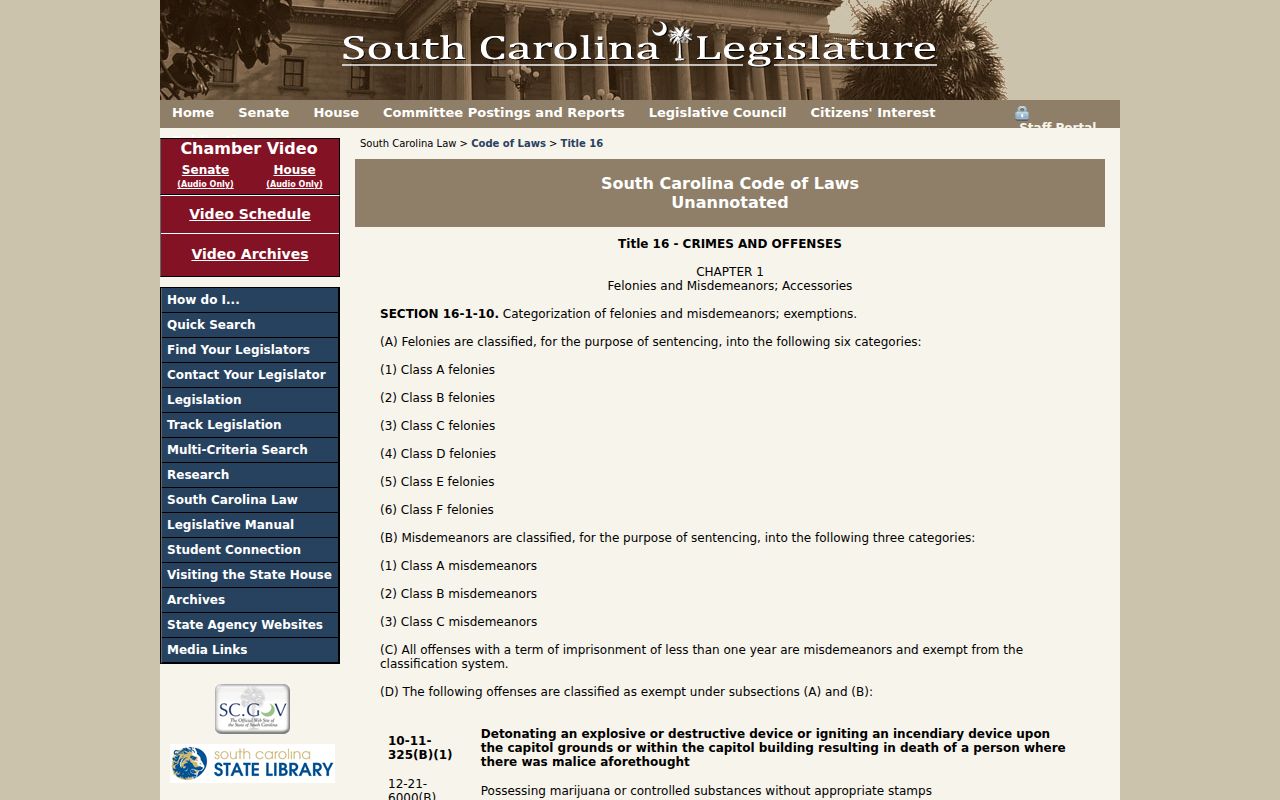
The statute must be read with the law defining the exact charge because offense-specific terms and exclusions can control both punishment and later relief.
| Class | General maximum framework | Typical local court |
|---|---|---|
| Class A felony | Life imprisonment | General Sessions |
| Class B felony | Up to 25 years | General Sessions |
| Class C felony | Up to 20 years | General Sessions |
| Class D felony | Up to 15 years | General Sessions |
| Class E felony | Up to 10 years | General Sessions |
| Class F felony | Up to 5 years | General Sessions |
| Class A misdemeanor | Up to 3 years | Usually General Sessions unless assigned |
| Class B misdemeanor | Up to 2 years | Usually General Sessions unless assigned |
| Class C misdemeanor | Up to 1 year | As statute and jurisdiction assign |
| Unclassified | Penalty stated in offense law | Depends on maximum and specific grant |
This framework also affects expungement. The common first-offense route in §22-5-910 is limited to an offense carrying no more than thirty days, a $1,000 fine, or both, and it includes exclusions and waiting conditions. A broad misdemeanor label alone does not establish eligibility.
Laurens County Expungement Eligibility
Expungement is not a blanket deletion of any old record. A qualifying order directs destruction or removal of covered arrest and court records from public channels. Under S.C. Code §17-1-40, qualifying dismissals, no bills, and not-guilty outcomes can lead to destruction of arrest records, subject to statutory conditions. Other routes cover specified first offenses, conditional discharges, Youthful Offender Act matters, certain drug cases, fraudulent checks, and first failure-to-stop cases.
The General Sessions route begins with the Eleventh Judicial Circuit Solicitor. A dismissed magistrate or municipal matter starts with the summary court that handled it. SLED cannot begin the court process and cannot erase a Laurens County entry without an Order for Destruction of Arrest Records. Eligibility turns on the charge, disposition, prior history, waiting rules, and statutory exclusions. The case docket and certified disposition should be reviewed before money orders are purchased.
The General Assembly’s arrest-record statute shows the legal basis for qualifying destruction.
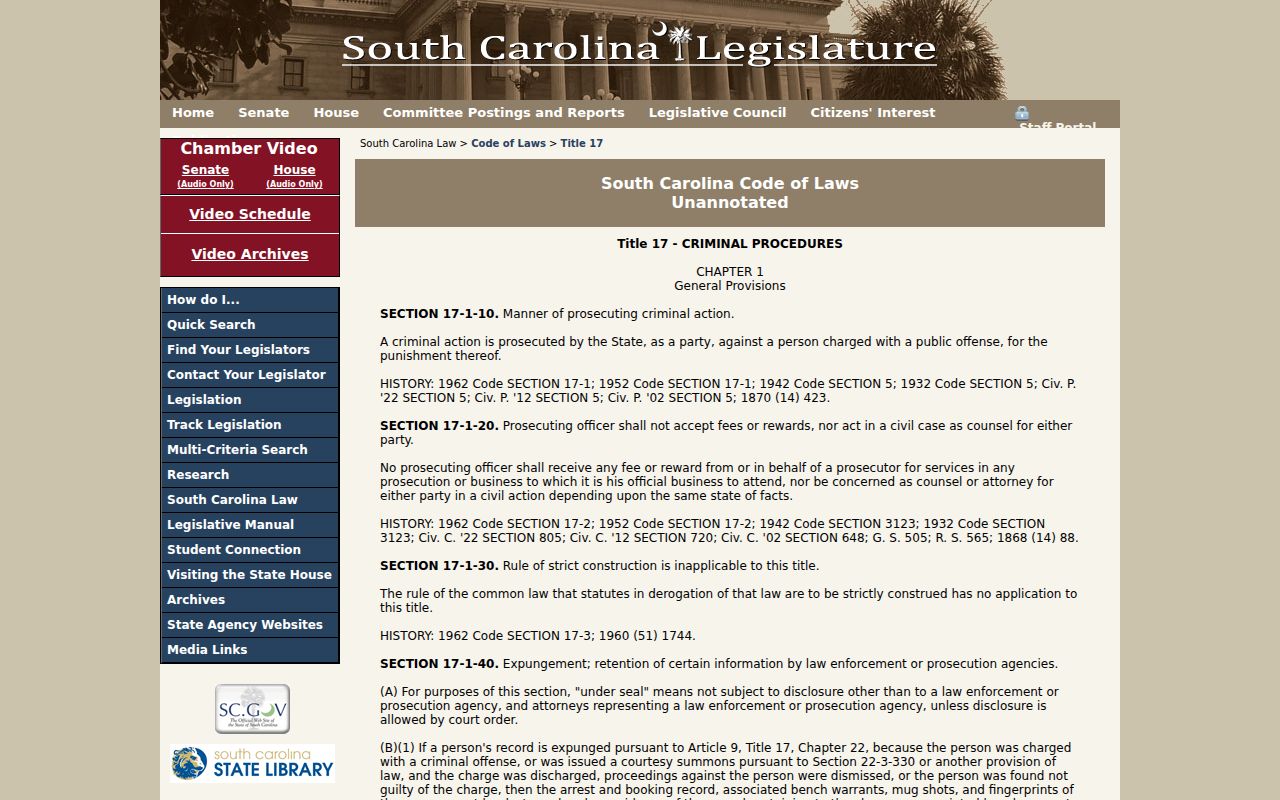
The official text helps distinguish relief after a favorable outcome from fee-based statutory paths that require more eligibility review.
Eleventh Circuit Expungement Application
The Eleventh Judicial Circuit Solicitor’s expungement instructions govern Laurens County General Sessions applications. The 2026 chart lists no administrative, verification, or filing fee for qualifying dismissals, nol pros outcomes, no bills, and not-guilty verdicts. If a dismissal was part of a plea agreement, a $250 administrative fee applies. Other eligible categories generally require separate $250 administrative, $25 SLED verification, and $35 clerk filing payments.
Conditional discharge under §44-53-450 carries a $250 administrative fee and $35 filing fee, with no verification fee on the published chart. Fees are nonrefundable and must be separate U.S. Postal Service money orders. The application says no address is needed on the money orders for the Solicitor, SLED, or Clerk. Identity-theft false-accusation documents form the stated waiver exception.
The current application calls for the applicant’s name and contact details, aliases used at arrest, birth and identity data requested by the form, arresting agency, arrest date, charge, court, disposition, and warrant, ticket, or case number. It also asks for the eligibility category, prior-record information, signature, and date. Supporting disposition papers and identity-theft documents apply where relevant.
Note: Confirm the current fee chart before buying money orders because the correct route and payment set depend on the exact disposition.
After a Laurens County Expungement Order
An issued order must move through the agencies that hold copies of the covered record. The court, arresting agency, detention system, and SLED each process its own data. SLED recommends allowing four weeks after it receives the order before purchasing a new CATCH report to confirm the state repository update. The order does not guarantee that a private database changes at the same time, and SLED has no control over a private operator’s files.
If the old charge still appears in CATCH, SLED directs the subject to mail a certified true copy of the expungement order, a recent CATCH report purchased within thirty days, and a stamped self-addressed envelope to SLED Expungement Department, P.O. Box 21398, Columbia, SC 29221. Keep copies of the full packet and proof of mailing. A fresh CATCH report provides a clear snapshot of the state entry being disputed.
Relief should be checked at the correct layers. Confirm the court docket or clerk record, the source agency record, and the SLED history. If a federal identity history still shows a state event after South Carolina relief, follow SLED CJIS guidance because state-to-federal reporting may need a separate update path.
Correcting Laurens County Criminal History
A correction differs from expungement. Correction fixes an inaccurate or incomplete record; expungement removes an otherwise valid qualifying event through legal relief. First identify where the error began. The arresting agency controls its incident and arrest submission. The clerk controls the filed disposition. SLED’s Computerized Criminal History Unit controls the statewide repository entry assembled from those reports.
When a CATCH report lacks a disposition, obtain a certified disposition from the court that decided the charge. General Sessions records come from the Laurens County Clerk at 100 Hillcrest Square, Suite B, 864-984-3538. Summary dispositions come from the relevant magistrate or municipal clerk. Then follow the SLED CJIS correction instructions. A name-based CATCH mismatch may also stem from aliases, spelling, birth data, or starts-with search logic, so compare identifiers before alleging that the repository is wrong.
Federal records are a separate layer. The FBI Identity History Summary is a subject-only fingerprint review, not a Laurens County court file. If a South Carolina correction or expungement has not reached the federal record, SLED directs the subject to contact its CJIS unit. Preserve certified records and correspondence so each office can trace the transaction.
Correction path: Verify the source record, secure the certified court outcome, send it to the responsible agency, and confirm the result through a new official report.